
Days 39–42 (29 April–2 May), following Monday’s successful concrete pour, see heaps of tangible progress being made. Every day has a new and pleasant surprise as:
- the formwork for the upper path is stripped off
- the carpenters make rapid progress installing the lower floor beams for the main house
- the last of the current round of scaffolding is finished
- and the steel fabricators return and erect most of the structural steel poles for the art studio
Your blogger is often struck by how the old and the new can be effectively combined; building methods and materials are no exception. Where once solid hardwood timbers were used exclusively, since the 1970s laminated veneer lumber (LVL) products have become widely used. These low-cost, environmentally friendly ‘engineered timber’ products are as structurally strong as hardwoods, steel and concrete but they have many advantages including their light weight and that they can be made to almost any length.
Our LVL hyspan beams are sitting on the steel posts on the perimeter; this construction engineering method dates back to ancient Greece and all that’s being done differently is bolting these ultramodern beams to cleats welded onto the posts, so we don’t have to rely on gravity to keep them there like the Greeks did. No doubt Vitruvius would be thrilled to see the ancient method combined with the modern material. Then I-beam-style LVL hyjoists are installed between the beams using galvanised steel brackets. Pictures being worth 1000 words, here are a few:
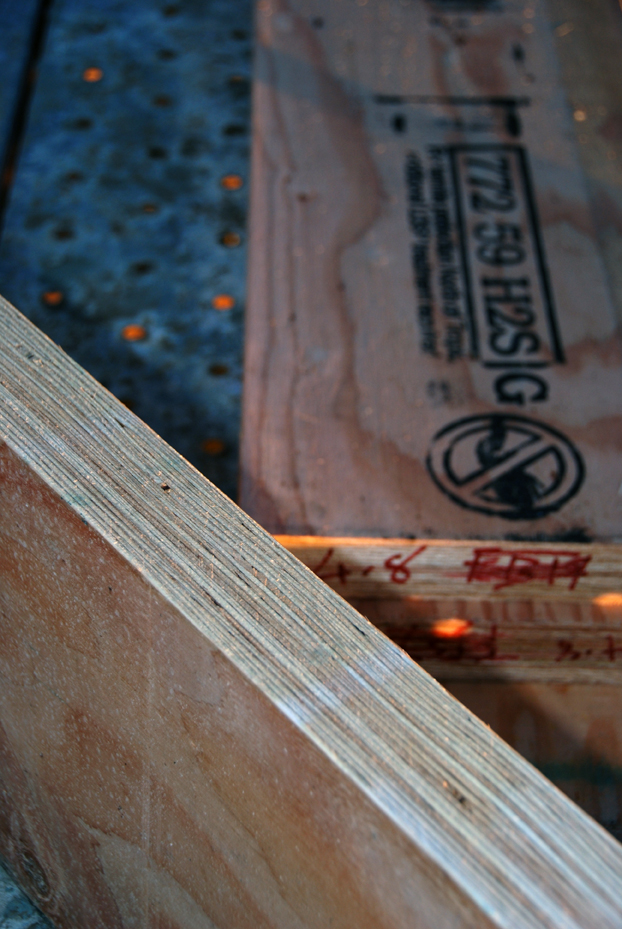
Hyspan beams. These are 240 mm x 63 mm x 4.8 m (9.5″ x 2.5″ x 5.25 yds) long. They are mainly used around the perimeter and sit on the steel poles. The laminated layers give them incredible strength.

LVL hyjoists, in the same height as the hyspan beam above. These are super strong too and easily moved around, cut and fitted, and handled by one person if needed. The vertical part of the ‘I’, known as the web, is made from oriented strand board (OSB). These I-beams can be used to span distances up to 12 metres (13 yds); these are short at about 5 metres (5.5 yds).

Nathan handles an LVL hyjoist easily. Carrying a steel I-beam of the same dimensions would require 3 to 4 people and negotiating such a steep slope would be very dangerous.
Installing these beams is another tangible reminder that from here up this is a timber house.

The first of many being readied – and one of the few to be installed close to the ground. The threaded rods were placed during the pour and this hyjoist will be about the only one to be secured using that method.
Day 40 sees the perimeter coming along well (below). The scaffolders in the background contemplate their next move to try and stay ahead of the carpenters.


From the bottom up: core-filled blocks, damp course, bottom ‘plate’ and beams
Day 41 will be the test for lightweight LVL construction methods and materials.

Sunrise, Day 41. The scaffolders almost finished the previous day!
Another day sees old and new methods used.

String lines have been used continuously for hundreds if not thousands of years

The hyspan beam sits on the post and is bolted to the cleat. Soon the brace will come off.
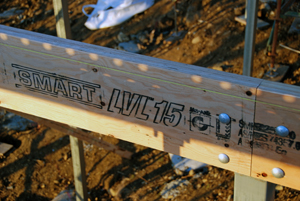
String lines never lie!

Day 42, Friday morning, 7.45 am: Damien (left) and Jib getting set up for the last day of work this week. Big progress is registered by the end of the previous day, Day 41. It’s a good thing as today may be a short day; rain is likely.
When ancient methods are appropriate use them. When ultramodern methods come available, use them too:
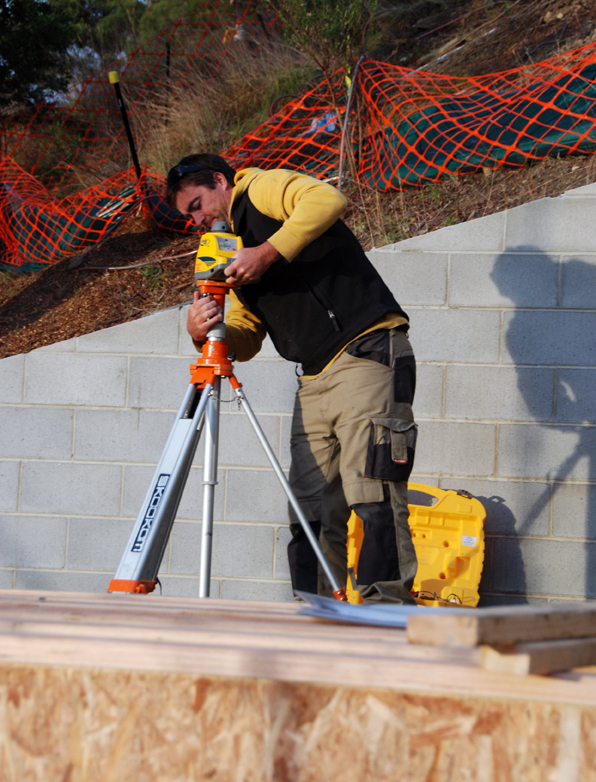
Nathan sets up the laser level at the start of Day 42

The carpenters weren’t the only ones making big advances ahead of the last day of the week. Day 41 saw the scaffolders finish their first stage, with handrails and toe boards in place as required, just in time for the steel fabricators, Mark and Justin, to weld all but one of the art studio steel poles in place.

The end of a BIG week is marked by calm and tranquility after the rain on Day 42.


 Hobart hill house
Fascinating to watch and learn. Much more exciting than a Lego construction!
Gwen and Ron, I couldn’t agree more. Spending a bit of time almost every day on the block recording the progress and briefly interacting with the highly dedicated and skilled people doing the work is a privilege.
Loving the beams, that’s my kind of material!
Mike, there’s plenty more timber to come. Enjoy!
Gotta love those LVL beams. So sensible to use lighter materials when building on a ski slope! Do you have white ants in Taz?
Michele, as the link here indicates, white ants, aka termites, pose no threat in Tasmania. There is only one other very small part of the country where that is true. Besides their light weight and structural strength, timber or engineered wood products have other key benefits. More on those in a future post.