‘Tree change’
Leaving major urban metropolises such as Sydney and Melbourne for Tasmania isn’t something we were the first to do. People have been doing the ‘tree change’ for a long time. In fact, the person who Jenny bought her Marrickville (Sydney) house from in 2001 moved to West Hobart. Maybe that planted a seed in Doug’s mind for the future. And Jenny says she wanted to live in Hobart since she was a child growing up in Sydney.
The design process began with architects Uta and David Green of Green Design, South Hobart, in early 2012. But before we engaged them, we bought the vacant block of land on Woodcutters Road, Tolmans Hill. What attracted us to this block?
The place
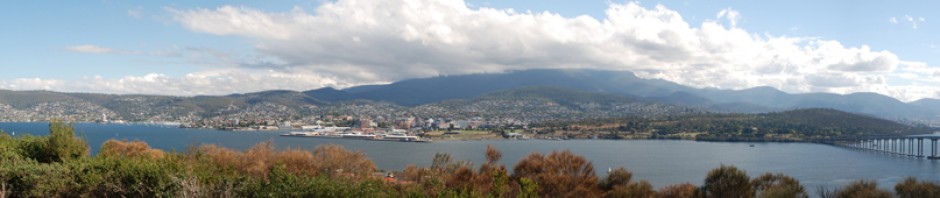
- The panoramic view: of Hobart, the Tasman Bridge, the Derwent River and Meehan Ranges and Frederick Henry Bay nearby; and on a clear day some 50 km (30 miles) to the east as the crow flies, the Forestier and Tasman peninsulas.
- The orientation of the land in relation to the sun. We had numerous choices of land along Woodcutters Road with almost identical views. The striking difference was ‘solar access’. The block runs almost perfectly east–west, which we knew would allow for a house that would face north to capture the warming sun in the colder months in Hobart’s ‘cool temperate’ climate. And Jenny’s art studio needed to receive even, indirect southern light rather than the glary northern sunlight, while still getting the views, whether for subject matter or inspiration.
- The proximity to the city. The drive from Woodcutters Road to the centre of Hobart takes about 7 minutes. We had early on briefly considered buying land out in the bush, say a 30-minute drive from Hobart. We compared that driving time to how far 30 minutes gets you in Sydney, where every hour is more and more like peak hour, especially on Saturdays. But we soon thought better of it, recognising that especially as we get older being on the fringe of this small city gives us the best of both worlds: access to services, public transport, eateries, galleries and museums, the State Cinema, oh, and medical care, to name a few, along with beautiful bushland to walk in just up the road.
- The trees and the bushland thicket at the bottom, south-east corner of the block. We liked that Tolmans Hill, which was only recently opened up to development (ca 1999), is meant to remain a bushland residential suburb: no front fences, no lawns on street frontages, native plants instead with side fences, if desired, set back from the front boundary by at least 6 metres (20 feet) and house and roof colours sympathetic to the bush setting. We thought that protecting, preserving and caring for the native flora on the block was an important responsibility.
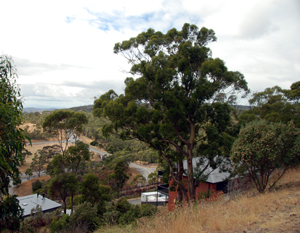
Looking down from the footpath at the site with the two mature gum trees at its heart
And we loved the fact that the birds and local marsupials enjoy the ambience of this land too! Designing the house with the existing plants as central to the project also meant once the house was built it would feel established as part of this place immediately; we wouldn’t have to wait 10 years for the landscape to recover from the inherent violence of the building process.
- Low maintenance. Aside from being relieved, no, thrilled, that there would be no grass to cut, we wanted a house that wouldn’t need repainting every 5 years or refinishing timber floors every 3 years due to wear and tear from our next (big) dog. That’s just one aspect of both functionality and materiality that we considered: what materials could we use that will keep us from spending huge amounts of time and money to maintain the house, especially as we age.
- Low side of the hill. We liked this block precisely because it was on the lower side of Woodcutters Road. That position meant we wouldn’t have a ‘look at me’ house with a ‘grand’ façade. We wanted the house to be part of the place where it is built, not the sum total of the place. And this place meant the house could nestle in around the gum trees, be less visible from the street and the floorplan would allow us to enter the house on the kitchen/dining/living level with the bedrooms on the lower floor.
In June 2012, David and Uta presented us with lovely hand-drawn concept sketches for a pole home wrapping around the two main existing gum trees, the upper one a peppermint gum (Eucalyptus pulchella) and the lower, a white gum (Eucalyptus viminalis).

The architects’ main hand-drawn concept sketch for a pole home on Tolmans Hill, looking from the footpath above. Courtesy Green Design

Computer-assisted concept drawing of the southern elevation. Courtesy Green Design
House size
How much space do two people need? Is bigger better?
- Australia has the largest average new house size in the world: in 2009 the figure was 214 square metres (2303 square feet).
- Leaving aside the obvious gross waste of resources to build, furnish and maintain them, this trend in many wealthy countries experiencing declining population growth has meant bigger and bigger houses occupied by fewer and fewer people. It’s plain nuts.
We asked for a house size suited to two people and occasional guests. At around 150 square metres (1600 square feet) of habitable space, it is still about double the space we lived in in Sydney.
Site plan and floor plan
We knew a very steep site meant all kinds of design and building challenges. How steep is it? Very. From the footpath to the bottom of the block (about 41 metres or 135 feet), the drop is 18 metres (59 feet). Not quite a 45-degree slope but call it 40.
So getting to and from the house meant a functional challenge: either a bridge, stairs or a path. The architects designed wide, easy-to-use stairs with very deep treads and low risers that intersect a gentle path that cuts across and down the slope and then back across to the entrance, utilising almost the entire 22-metre (72 foot) width of the block.

Looking at the site from above: the stairs and path down to the house and the 2 mature gums shown as circles. Courtesy Green Design
The house has 3 levels. The upper, entrance level has a bedroom/study, a full bathroom with a shower, a storeroom and an open plan kitchen-dining-living area. There is one internal staircase at the far end of the house. Halfway down is the door to Jenny’s art studio, which sits at a right angle to the main house, in a separate ‘pavilion’. Continue down the stairs to the lower level of the main house with its 2 bedrooms, a bathroom with a separate bath and shower and a laundry. It’s a simple floor plan, with all rooms except the upstairs bathroom, storeroom and the downstairs laundry having the view and solar access. But simplicity is complex. More on that in a future post.

Computer-assisted drawing of the north-east elevation. Courtesy Green Design
Universal design
Universal design, inclusive design and ageing in place are related ideas that make buildings, the built environment and specific products accessible to everyone regardless of their age or state of health. They’ve been around a long time now and are constantly being revised and updated. But because housing is mainly built to make a developer a profit, how often do they get incorporated into new housing? Put another way, how many people reading this blog live in a place where there are no obstacles or hazards that will either prevent them from remaining where they live as they get older or will create risks of falls and other preventable accidents. Very few, we imagine.
Without even mentioning these terms, our architects designed the access to and from the street, the width of doorways, hallways and stairways, the near-level walk-in, roll-in shower access and many other features with these principles at the forefront. We will initially welcome these features as part of a joyous moving in, not driving ourselves crazy negotiating narrow hallways and doors. Later, as we age, we may find all these features critical to our ability to stay put. Now is the time to include them!
What about our internal stairs, though? We believe stairs are good. They keep you fit. They contribute to good quality of life for people, especially those over 55. And 14 stairs with a landing in the middle shouldn’t be a problem. And if it does become one? The wiring will be in place to install a stairlift on these wide stairs, which won’t impede anyone who can walk from doing so. And if we find we can’t afford a stairlift if the time comes, the house has been designed so we can just live on the upper floor, with a full bathroom, kitchen, bedroom and those beautiful and ever-changing views.
We took our time with the design process. considering ideas and options from as many angles as we could think of, especially functionality, materiality and delight. And budget. The fruits of that collaborative thinking process will be seen as the construction progresses and theory and practice come together.


 Hobart hill house
The whole concept is so well considered. The drawings are beautiful. Note to self – DO this one day!
Thanks for your kind words Warrick. There will be a post at some stage about our architects’ serene concept drawings and their relationship to the computer-assisted design (CAD) drawings. One of the heretofore unspoken ideas motivating our blog is precisely to encourage others to do this one day if you can.
I like your universal design thoughts. Very wise. Mike & I are following your blog with great interest 🙂
Thanks Caterina. We are fortunate to live at a time when some very smart people have thought deeply about removing barriers through universal design. All humanity should be entitled to be the beneficiaries of their work!