
By reputation Tolmans Hill is a windy place. Very windy. So windy that many Hobartians would never consider living here. That attitude is prevalent because much of the northern end of Tolmans Hill – with its view of the mountain itself in addition to much of what we can see from our site – is exposed to the wind from all directions and the houses there were built pretty much on the top of that part of the hill. It’s that end of the suburb that has given this Hobart neighbourhood a bad name when it comes to the wind. But the Tolmans Hill we know is different – and today’s experience on site proves it.
Winds on days like today typically roar off the mountain heading east toward the city at 100 kilometres (60 miles) per hour. They shoot across the foothills and valleys and, though dissipated, smash into the western side and the northern tip of Tolmans Hill.
At 9 a.m. in Hobart winds of 35 kph (20 mph) and gusts up to 54 kph (34 mph) are recorded by the weather service. And they get worse as the morning continues. But when your blogger arrives on site at midday, Jib answers the questions ‘How’s the wind been’ … ‘Did you have to stop work’ with ‘Good’ and ‘No’. His surfer’s and sailor’s explanation confirms what we thought when we chose this site: building on the eastern side of the hill protects us from the harsh predominant winds, which are westerly or south-westerly in Tasmania. So while it is almost blowing a gale a 10-minute walk to the north of us, all we experienced was a steady breeze. Northerly and southerly winds, which do directly affect us, will be the subject of a future post.
So instead of the morning being a write-off, good progress has been made.
While the steelies were busy yesterday with the beams, the team of carpenters started preparing for installation of the fibre cement sheets, the underfloor insulation and finally the ‘green tongue’ subfloor sheets for the lower floor of the main house. Today the team is making further progress and doesn’t have to worry about sheets becoming airborne in fierce winds whipping the northern end of Tolmans Hill.

First the fibre cement sheets are measured and cut to size to fit in the compartments, resting on top of the lower flanges of the I-beams.

Jib lays a bead of glue all around the two lower flanges before placing the sheet in the compartment on top of the flanges.

Next the fibre cement sheets are secured to the flanges using the nail gun. Between nails and glue, they’re going nowhere when high winds pass under the house.

Before they are sealed with the green tongue sub flooring on top, a last look at the way the LVL I-beam Hyjoists are connected to the LVL perimeter beams using metal joist hangers.

The R5 insulation is then stuffed snugly into the compartments before the subflooring is laid, closing it all up.
A snug fit for insulation is critical. Gaps that allow air leakage will compromise the performance value of this crucial element and allow unnecessary heat loss in winter and heat gain in summer. These polyester insulation batts with an R5 rating are 240 mm (9.5 in.) thick, which should do the trick! Roof and wall insulation is traditionally very important too, but experts also estimate that on average 30% of heat or coolth is lost through floors into the external environment. These days, many recommend that even a concrete slab poured on the ground should have rigid insulation between it and the ground it sits on.
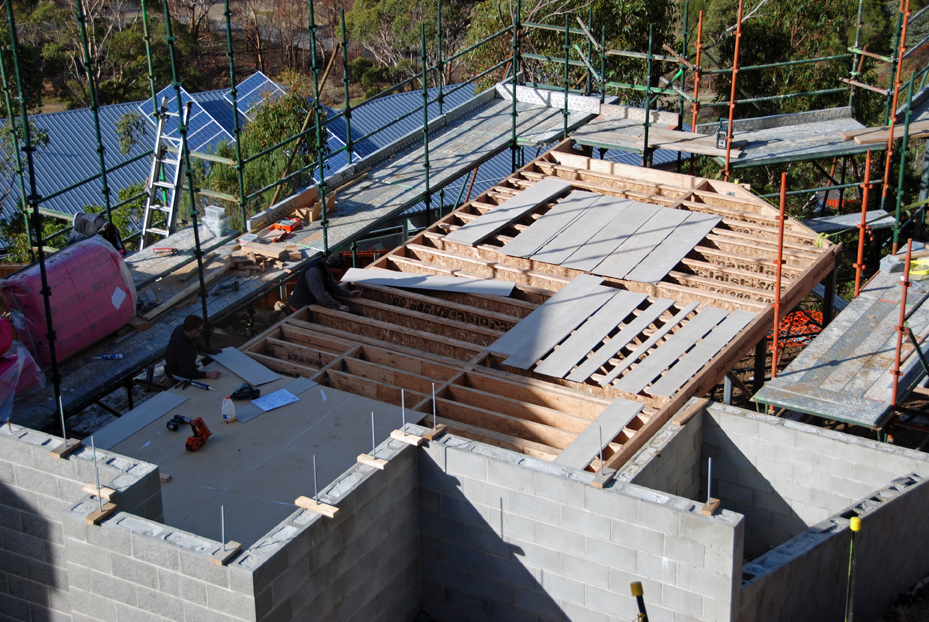
Progress just before lunchtime, Day 44, May 6.

Our architects, Uta and David Green, have a look at their ideas being transformed into reality. They are very pleased with the progress to date!


 Hobart hill house
Nice floor structure! Should be very snuggly!