
The project has arrived at a small fork in the road: to move rapidly ahead with scaffolding , which allows a start on the lower timber floor of the main house and the studio and their wall framing, or unusually, move to prepare the upper path’s formwork and get the initial concrete pour done.
Typically, the path would be left to the end of the project to avoid damaging it through the course of the build. But access down the slope to the house remains so difficult that this is really a no-brainer. The safety and efficiency gains by doing something out of the ordinary are too big to miss. So Ian and Nathan, the site foreman, decide to concentrate on getting the path to the point where it will be useable, even if not fully finished. And in the meantime the steel pole erection can continue and scaffolding begins too.
The engineer, Leigh, redesigns the path in two parts: the first is a 300-mm (1 ft) thick L-shaped slab and block wall that will retain the fill used in the road embankment and stop any movement in it from affecting the slope or the house. The second, which won’t be installed until toward the end of the project, will be a 75-mm (3 in.) topping slab. So the formwork and steel reo work begin for the bottom slab.
Once again, the realities of the site mean modifying the approach to get the best result.
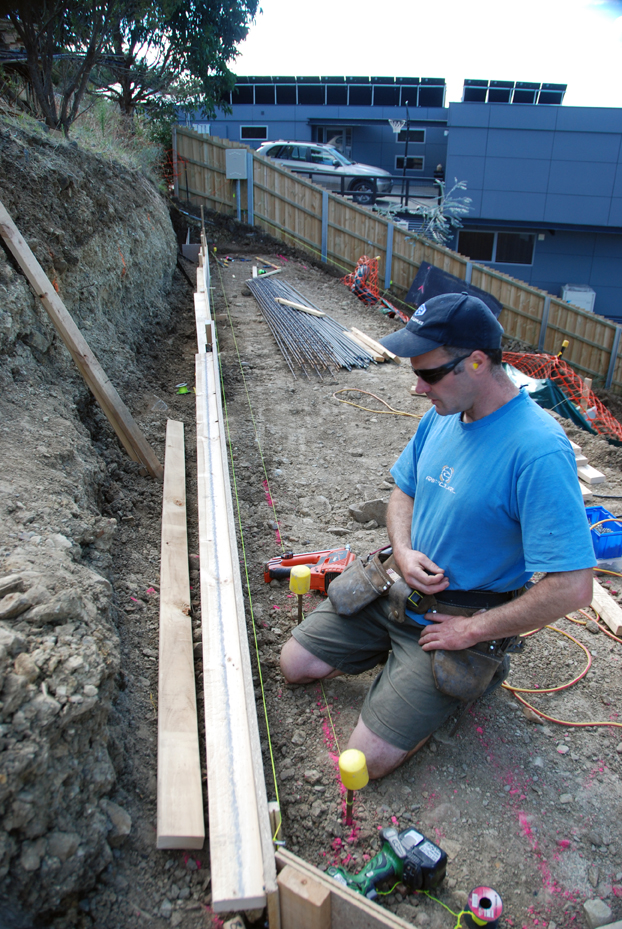
Day 32: Damien working on the initial stages of the formwork for the upper path.
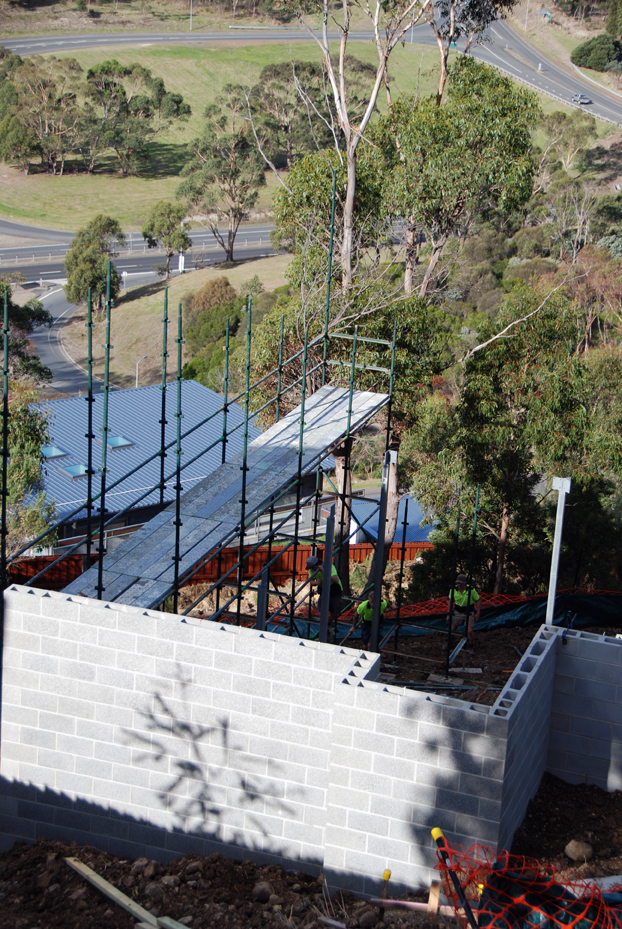
Day 35: the scaffolders have been at it all day getting their materials down onto the site and have made good progress. Look closely and you’ll see one scaffolder at work. At this initial stage, only enough scaffolding will be erected to work on the lower floor of the main house and the art studio, so there’s plenty more to do.

Day 37: An advantage to scaffolding is being able to stand on it to get better photos! The formwork for the upper path and the reo are done, ready for the pour on the next working day. The formwork on the right is for a landing where the lower and upper paths will meet. The lower concrete path will be created later using different methods.

Standing at the landing looking up the path to be. Very heavy-duty steel reo has been used to strengthen the 300-mm (1 ft) thick concrete slab. Architects David and Uta designed both paths to have the same gentle fall of 1:10, i.e. for every 10 units of length the path drops 1 unit in height. This should allow us and anyone else so inclined to easily access the house if the stairs aren’t an option.

Looking down the path to be. The vertical steel reo on the left will be buried inside a low concrete block wall that will retain the slope behind it. The block wall, never beautiful, will be covered on the top and face with local stone. The formwork box in the foreground on the right will form the upper landing where the stairs and the path will intersect. When the work is all done we will have choices: stairs-landing-stairs, path all the way or a combination.
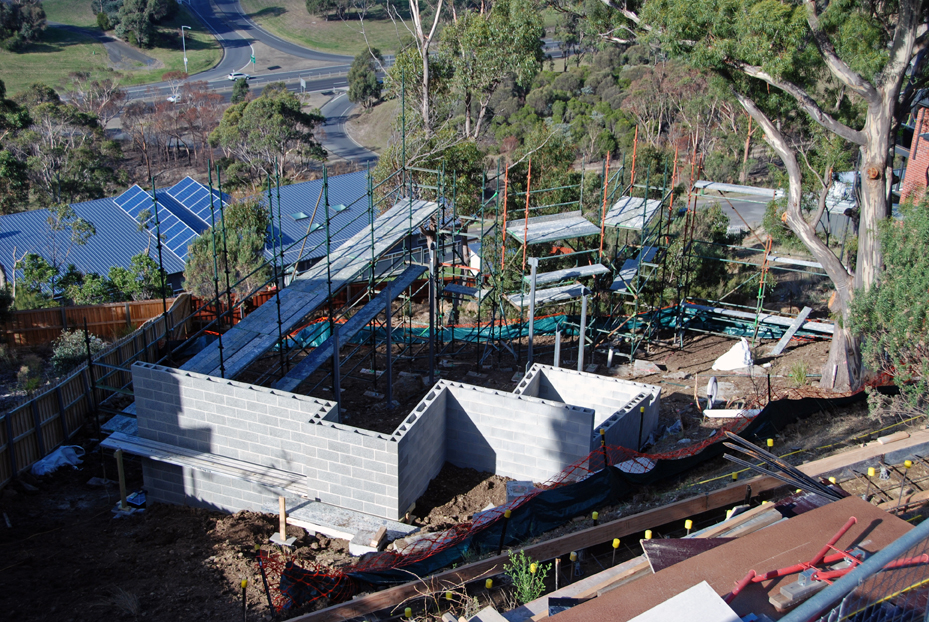
Expecting rain that didn’t arrive, the scaffolders weren’t to be seen on Day 37. But they accomplished more on Day 36, their second day, as seen here.


 Hobart hill house
Doug, just catching up with this. Will be following. I am sure will be very lovely. Elizabeth says she has always dreamed of going to Hobart because of the old trees. Now another great reason!
Bill
Thanks Bill. Tasmania’s natural and built environment can offer visitors and residents delightful things. In the big tree department this Australian Geographic site along with Tasmania’s giant trees are useful. As for historic buildings, this state is renowned for the quality and quality of its heritage-listed places. When you and Elizabeth come, leave three weeks for Tasmania alone!